On hiatus:

///Be Back Soon///

///In the meantime, read my posts, comment, contact me///

Monday, 29 September 2008

Interview: LAURA IZIBOR


Laura Izibor enters the studio, dressed head to toe in black: jacket, jeans and boots. Her curly hair is full of life and makeup flawless; her smoky eye shadow completing the look. Gone is the fresh-faced, girl-next-door I had come to know from her MySpace pictures. In her place? A soul chick that rocks. As we talk her Irish lilt is occasionally inflected with a soft American twang (a consequence of spending ample time in the US with her record label Atlantic) and the laidback Irish charm is apparent. Featured in our Rising Star Spotlight late last year Laura Izibor needs no further introductions.

Despite the delay of her debut album, Let The Truth Be Told, Laura has been busy. Though you may not be completely familiar with the name yet, the music will certainly sound familiar. Her track From My Heart To Your's appeared in an episode of the medical drama Grey's Anatomy and Carousel was specifically written as the theme song for the film Nanny Diaries (2007). Whilst her gospel-influenced Mmm featured in not one, but two films: Why Did I Get Married? (2007) and Step Up 2: The Streets (2008), respectively.

Right about now the Irish soulstress is feeling 'Really damn good!' and with good reason. Not only has the film world been paying attention, but with the recent votes from Rolling Stone and Vibe Magazine as Artist to Watch 2008 it seems the rest of the world is too, 'It's taken a really long time to get this record finished; so to get this kind of love, it's crazy,' she tells me.

Considering the buzz around her music, the 21-year old's feet remain firmly on the ground and she reveals the perfect remedy for coping with the expectation prior to her debut release, 'I don't have any expectations for myself; that's the way I try and live my life. I'm just really enjoying singing and playing, just doing what I do.'

Unlike other young female acts who have come and gone before, Ms. Izibor will never be branded a 'studio chick' but a seasoned performer instead. What you get on the record is what you get in person; so when the lady performs live, she performs. Having opened for Angie Stone, the late James Brown, Al Green, The Roots and Jamie Cullum is there need for any more proof? 'Performing live is what you work for - it's the adrenaline, it's the buzz', though this does not mean her love of studio time is any less deep, 'at the same time the creative process is a lot more personal - it's an inward achievement. I couldn't live without the both of them.'

In tune with Izibor's laidback personality is her method of writing; imagining her with a pen and a pad, would be inaccurate, 'I don't write my lyrics down, I just usually record myself on a Dictaphone or whatever I have and just play, mumble, sing and vibe. When I listen back I'm like, 'Oh I see what I was trying to do there' and put a little bit of structure in, a little bit of edge and the song usually just writes itself. Sounds cliche, but it is just a natural process and that's the way I try to keep it.' When asked if there is a special someone to inspire her, she laughs and says, 'Not at the moment. I'm so busy I don't even get time to see my family.'

Now a little older, wiser and more experienced Laura is pleased that she took the time to work on her talent before putting herself out there, 'It took me a very long time and there was a lot of frustration, but it taught me an awful lot. I would still say to someone wanting to get into the industry to work on your skill, get a good demo and send it to record labels and song writing competitions. It's important to take every opportunity that you see; you really have to have no insecurities and just believe in yourself.’

With a 2009 release of Let The Truth Be Told, her debut album of home-cooked soul with an edge, Ms. Izibor is more than prepared. 'I'm most excited about walking into a store and seeing the record on the shelf and just being able to buy it myself. Let The Truth Be Told is an album that I'm proud of and that I believe in. I've been very lucky to write my album 100% so there's nobody else's words there or visions. The album is completely my truths and my experiences.'

© Rachelle Hull, 2008

Published at www.originsmag.com

Interview: SHAGGY


Mentioning the name Shaggy is like playing word association, as Boombastic and Mr Lover Lover immediately spring to mind. Best known for his massive hit singles It Wasn't Me (the biggest selling single in 2001 in the UK) and Angel, the chart topping reggae superstar has been filling our ears with his trademark sub-baritone vocals and patois infused lyrics for well over ten years.

But where did it all begin? In Jamaica. 'I remember the first time I saw Yellowman live and that was it for me – I caught the dancehall bug.' It was when he moved to America that things really took off, 'When I came to the states there was a huge dancehall scene in New York. I started chatting on sound systems, free styling and after a while I just started making records.' Yet it wasn't until the release of Oh Carolina, a dancehall remake of the 1960s classic, which made the music industry take note. The track was passed on to Greensleeves Records where it garnered major attention in the UK in 1993, causing Virgin to come a-knocking at Shaggy's door.

Despite his growing popularity Shaggy was not without his critics, 'At the time Oh Carolina came out, I was being dubbed a one hit wonder. Almost all the headlines were saying I only had a hit because it was a cover. That aggravated me and I just had to prove them wrong; I had to get a bigger hit and it had to be one that I wrote – so I wrote Boombastic.' The single was an instant hit in 1995, reaching the No. 1 spot in over four countries; including both the UK and the US. His distinctive voice, humorous metaphors ('Well you a the bun and me a the cheese/ And if me a the rice well baby love you a the peas') and good looks cemented his (largely female) fan base.

Capitalising on this, Levi's jeans company used the track for its tongue- in-cheek advertising campaign that same year. Although Shaggy would go on to release bigger hits, it was Boombastic that established his signature sound. Fast forward thirteen years (and twenty million albums sold worldwide) later; the road from then till now has not existed without its potholes. 'I've not had the easiest of careers; I've probably been on about five record labels. When I did Oh Carolina Greensleeves wanted me to re-do that type of sound, I refused and then Apache Indian came out with a song called Boom Shack-a-Lack; which had the same feeling. I keep getting dropped because they want you to repeat what you've already done.' For Shaggy re-invention is key; and though it may not be done with dramatic wardrobe changes and excessive press coverage in the style of Madonna, it can be heard throughout his music.

Over the years Shaggy has collaborated with a barrage of successful artists, from Maxi Priest, to Janet Jackson, to Akon and with lesser known artists, like Rik Rok and Ravyon. His collaboration with renowned reggae artist Sizzla and newcomer Collie Buddz, on his 2007 album Intoxication, may come as a surprise to some. Entitled Mad, Mad World and waxing lyrical on the 'Politics, polytricks, equal econometricks' the record is a far cry from the usual party anthems like Hey Sexy Lady and What's Love. According to Shaggy this is not something new, 'I've always done these songs. If you listen to all the albums, I've got Why Me Lord, Keeping it Real, Hope, Gone with Angels.' His defence on why these particular tracks have never been released? 'Major labels would never put one of those songs out. Boombastic worked so that's why you have so many girl tunes; that's the formula they know and so they gear you towards that.' But aware of how the market works he explains, 'In defence of the record companies the kids at the clubs don't want to hear about social issues and radio won't play those songs. It's just like Kanye saying I won't get played because I talk about Jesus. It's sad, but it is what it is.' Though his albums were selling fast, like hot patties, Shaggy was losing his core fans– the lovers of dancehall. Something had to be done. Founding his own label Big Yard Music (a joint venture with long time manager Robert Livingston and producer Sting International), Shaggy had complete creative control. 'I needed to get the dancehall fans back, because they weren't feeling Shaggy. Dancehall fans that I had during Big Up and Boombastic have all grown up; these young kids only know Shaggy as the pop guy that's in Angel. I had to get the street back and Wild Tonight and Church Heathen were the songs to do it.' With its heavy baseline, dubbed the Heathen Riddim, and Patois lyrics in true Shaggy fashion ('Sister Gwen claim she a Christian/But a last night them catch her in a Stone Love session/She a do di dutty dance to the Matterhorn song') Church Heathen was sure to win back his lost fans. To ensure the track reflected what he was trying to do, Shaggy came up with the concept of the video (of which there are two versions) featuring Ninja Man and paid for them out of his own pocket. It worked. Church Heathen was a hit on the dancehall scene and across the globe.

Now in 2008, Shaggy is releasing his first official greatest hits collection; The Best of Shaggy: The Boombastic Collection. 'This is probably one of the few things I've done on a major label where I'm in full control; I picked the songs and the artwork for the covers.' Whether you've been a Shaggy fan from back in the day or you are a new recruit to the millions of fans around the world, with a track listing of eighteen songs there is definitely something for everyone.

Drawing on his own experiences in the industry, his advice for others? 'Your drive is more than anything else. You can't be successful in anything unless you're passionate about it; if you're going in there for money or fame it makes no sense. I would still be a reggae act if I started out now; I think it's almost like being a part of royalty. It is certainly not the easiest road; but I'm about being an artist, not really a celebrity. That's the secret to success – if there's a secret.'
© Rachelle Hull
Published at www.originsmag.com

Thursday, 10 July 2008

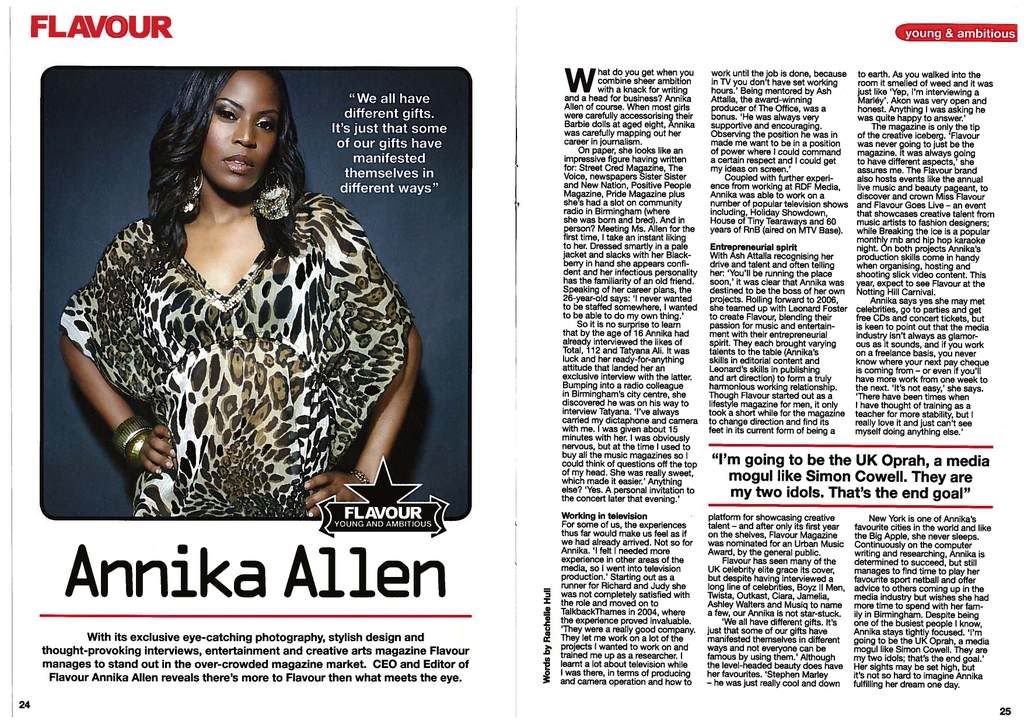
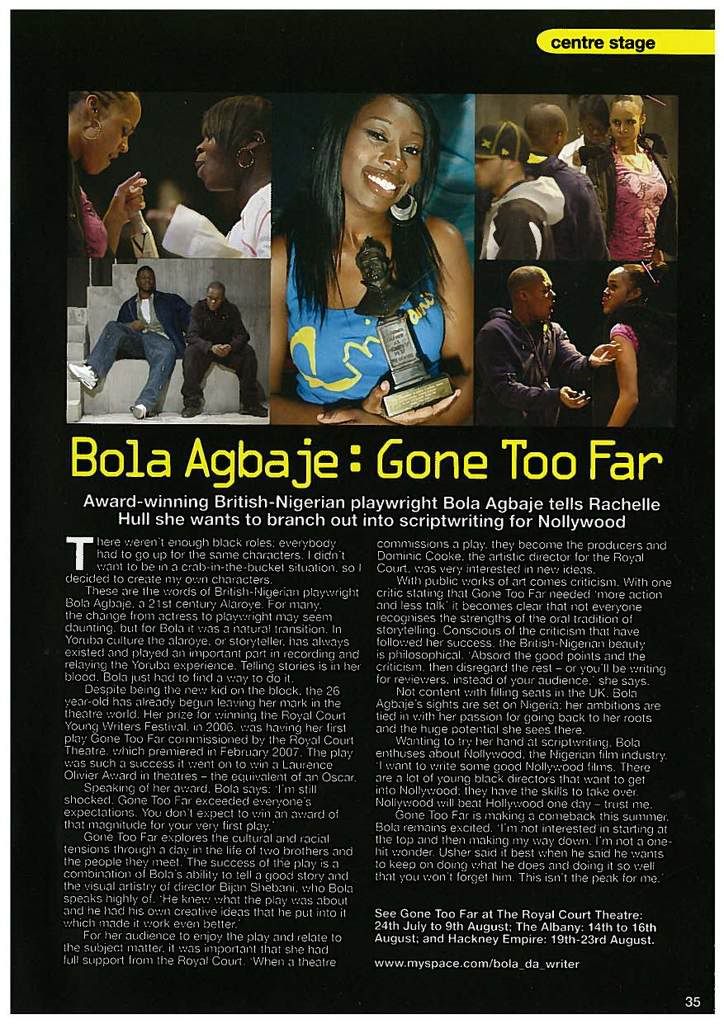
Interviews: ANNIKA ALLEN, BOLA AGBAJE and LORAINE FFRENCH

*Click on images for a larger view

CEO: Annika Allen


AWARD-WINNING PLAYWRIGHT: Bola Agbaje


DIRECTOR: Loraine Ffrench


Monday, 30 June 2008

ESSAY: Italian Vogue: Black Is Beautiful?


Italian Vogue is celebrating black beauty in July.

Or so they say.

Whilst many across the country felt joy at the news, I was still questioning their decision.

According to Vogue's editor, Franca Sozzani, her decision is based on the discrimination that black models face within the fashion industry (as well as the whole Obama phenomenon).

Though I cannot speak for everyone, I have never been in denial of the beauty that exists within my race. I do not need a book, a magazine, or anyone else to tell me what I see every day: in my family, in friends and in black women across the globe.

So I question the need for such a grand display from those who are usually hell bent on making the aesthetics of the black woman appear grotesque, to the rest of the world. For some this moment has been a long time coming, whereas I cannot help but feel a sense of déjà vu. Is it just me or does this reek of the Oscars black out: Denzel, Sydney, Halle anyone?

Is this July issue seriously going to change anything? I doubt it. The fact that Sozzani is reported as having said this will be ‘the worse selling issue’ is not dampening my reservations.

By making a standalone issue the highlight of the debate, ironically takes away from the wider discussion. This should be about a racist institution that makes millions every year from the same women it rejects. This should be about a racist institution that has been allowed to perpetuate its racism without being severely challenged and taken to task. Instead, this is about one magazine doing one good deed for the year, and yet black women are not a charity case. It is not just about the models either, what about the racism amongst the designers, fashion buyers and editors of these fashion magazines?

If it continues to be about the one issue, will this mean fashion no longer has to dole out another pity issue for, oh let’s say, another forty years? If ever again. Maybe I am being a bit too cynical - but can you blame me? This is what the Football Association does when there are cries against racism – they dole out fines that can easily be paid by the clubs and everybody moves on. This is what the (previously mentioned) Oscars did when there were murmurs about the lack of black actors and actresses winning the accolade – they doled out three for the price of one. So now it is the turn of the fashion industry.

Tell me, once the month is out and the sales figures are in, which point will be proven: that black is truly beautiful or that black girls ‘do not sell’?

© Rachelle Hull, 2008

Interview: GINUWINE


He was the sex symbol of the '90s. Creating a whole new meaning for the word pony with his debut single of the same name, Ginuwine graced our screens and ears with his silky smooth vocals, pretty boy looks and candid sex appeal.

Twelve years on and a couple of double-platinum albums later, the former bachelor is older, as handsome as ever and ready for 2008.

Considering his previous success one would think he had a complex about recreating work of the same calibre. But there are no pressure bars set-it's not his style, 'You can't go back and say I want to top Pony because Pony might not have worked now. You've got to deal with today's time and work around that and just try to come up with something for that time.'

It was in 1996, to be exact, when Ginuwine and the prolific producer Timbaland gave us Ginuwine...The Bachelor, his debut album. Back then, both the artist and the producer had been a part of former Jodeci member DeVante Swing's Swing Mob group (which also included Missy Elliott and Tweet at the time) before the group folded. The dynamite combination of Ginuwine's vocal talent and Timbaland's production skills is what made the album explode into double-platinum status.

Following on from his instant success, Ginuwine has gone on to release four more albums. His sophomore album 100% Ginuwine (also reaching double-platinum) in 1999; The Life (a platinum selling album) in 2001; Senior in 2003 and Back II Da Basics in 2005. Spawning numerous hit tracks from each release.

Judging from gaps in release dates it is clear he is not an artist who feels compelled to saturate the airwaves with his sound. His recipe for r n b: a dash of gentleman and a pinch of thug is what keeps his fan base solid. His declaration of, 'I just feel like I've got to make good music' and releasing a catalogue of substantial material when necessary, is what maintains the (level of) respect he receives within the music industry.

Speaking about the industry Ginuwine points out the major difference between the time he came out and now, 'You can do it all over the internet. It's all about promoting and marketing on the net.' Though he is quick to add, 'Make sure you've got a hit though because that's the key to opening any door.'

For 2008 Ginuwine is working on his sixth album, A New Beginning. His disillusionment with the current state of r n b, 'When we were making music it had more substance to it. You can't really knock what's going on right now, but it's not something I care too much for' and the decision, in 2007, to join forces with r n b hit-makers Tyrese and Tank to form the r n b supergroup TGT, one wonders if the title refers more to the genre than the artist.

Speaking of the new material he says, 'More sexy, smooth and laidback. I'm a little older now so I don't do the jumping around – been there, done that. I'm moving on to the Marvin Gaye feel.' For an artist who is known as much for his energetic moves as he is for his music, it is hard to picture a dance-free Ginuwine. Even he admits, 'When you come to a show though I'm a slave to the rhythm, so I'm gonna move.'

Proof that Ginuwine still has love for the occasional club banger is his current collaboration with UK producer Shayal, on the track Baby. The collaboration is the think tank of British-Asian producer Khiza for his 'culture meets culture' project, on the independent label Utopia Records. At a first glance the pairing of a US r n b star and an up and coming UK producer seems unusual. But with Shayal making quality r n b music and receiving support from other US artists, such as Rickey Rush (who has shared the stage with R. Kelly, KC & JoJo and Ginuwine himself), the duo make perfect sense.

Although some things may have changed for the man who brought us hits like In Those Jeans and Differences, one thing remains constant – his motto for success. 'You've got to work to achieve whatever you want in life. You can't lay back and hope it will come to you; you've got to get up and work.'

© Rachelle Hull
Published at www.originsmag.com
Friday, 30 May 2008

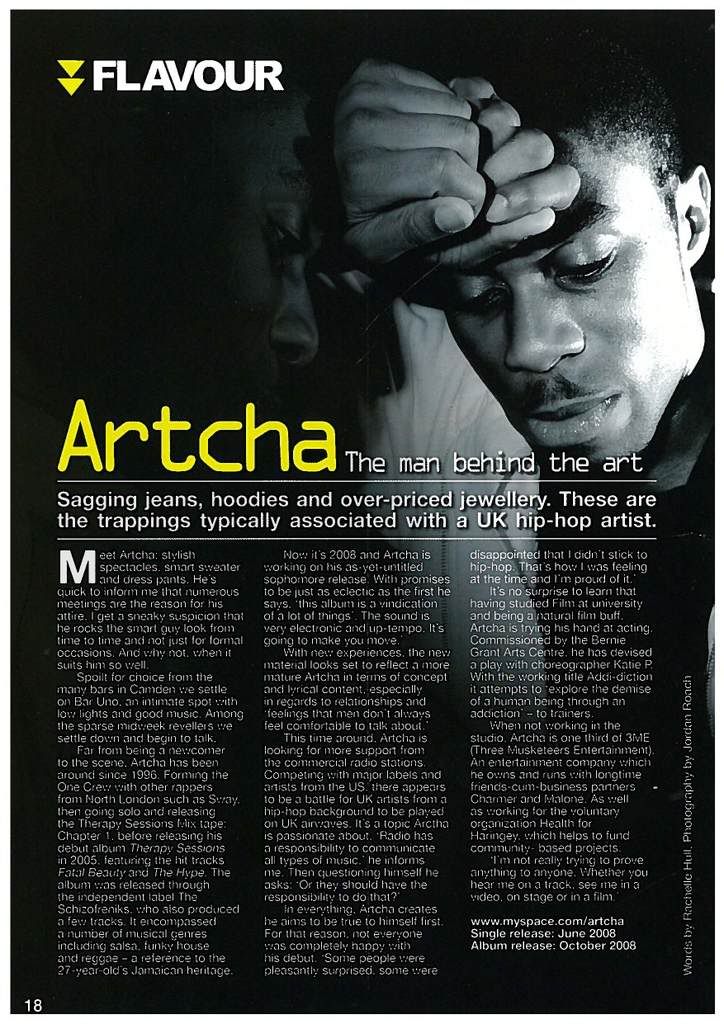
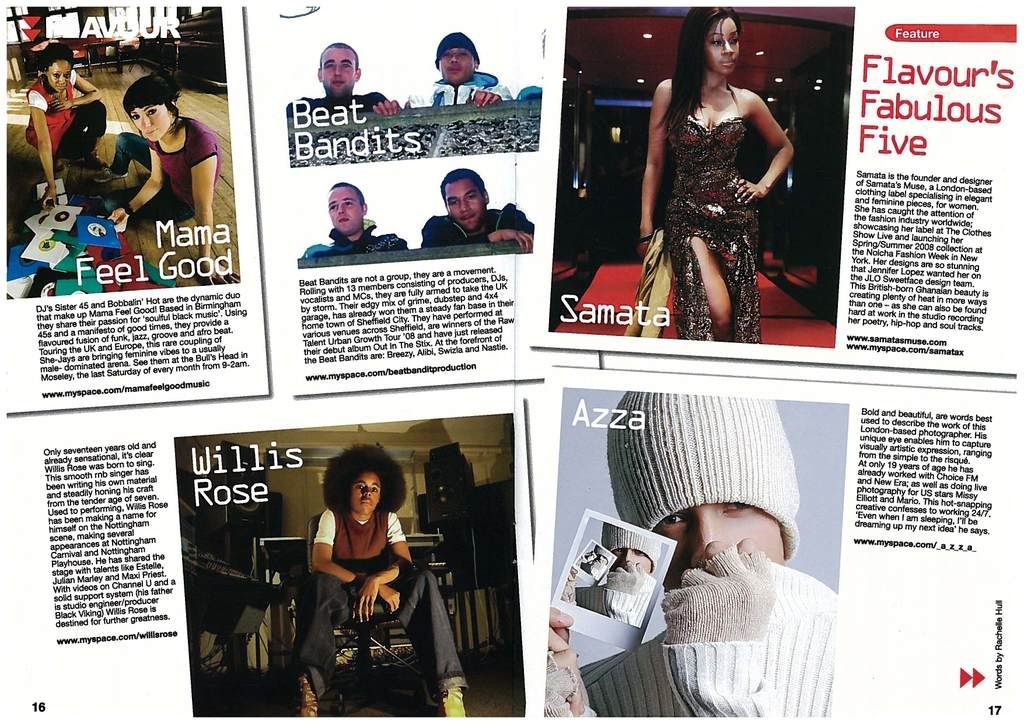
Feature: FABULOUS FIVE & Interview: ARTCHA

*Click images for a larger view

FEATURE: FABULOUS FIVE


INTERVIEW: ARTCHA
© Rachelle Hull

Friday, 25 April 2008

REVIEW: Adi-diction

Event: Adi-diction
Venue: Bernie Grant Arts Centre
Actors: Artcha James and Katie P

April 23rd 2008:


With an abrupt entrance, Artcha James and Katie P filled the small stage at the Bernie Grant Arts Centre. I was seated perfectly to watch both performers, as they stood in their positions: Katie lay sprawled on the floor, juxtaposed with Artcha's upright and rigid form. They maintained this for a little longer than necessary and with the promise of 'movement' in the advertising campaign, for a moment I thought I was watching the wrong play.

Adi-diction is about a young man by the name of Joe, who is addicted to trainers (hence the play on the word Adidas and Addiction to form the title). The 'story' does not unfold with your typical beginning, middle and end. Instead, it reveals itself in a sequence of soliloquies and confessions to the audience, often accompanied by music. Starting with Artcha, Joe's struggle is evident as he attempts to theorise the problem. Meanwhile Katie skips the bull and breaks it down, educating us on the variation of brands and styles: Adidas, Nike, Puma, Reebok, Airforce 1, Classic, Airmax, Superstar, Finster, Shox, Campus. Not being a connoisseur of trainers, I was lost among the lengthy list; but was quickly brought back into the fold, when the words 'honeydew', 'French lavender' and 'sweet cotton' escaped her lips - transporting me into her candy coloured world of laces and leather.

Whilst Artcha's role is evident from the get-go, Katie's takes a while to come to light. At one point she curled into the foetal position around Artcha's feet and as he stood, feet cocooned and lost in her embrace, I mistook her for a metaphor. Further on I realised Katie was not there to symbolise the trainer, both Artcha and Katie are Joe, just different sides of the same person. This is classic Freud: the ego and the id, the reality principle and the pleasure principle. Katie revels in the addiction, Artcha philosophizes it. A clever twist occurs when towards the end of the play you see Artcha change into the id, as Katie becomes the ego.

The clarity of roles makes for a more interesting play as it allows you to place yourself in the situation, substituting the trainer for your own vice. The ability to become so caught up in something, or someone, comes so easily to many of us that we are often unaware it is happening.

Although both performers were comfortable in front of their audience I was somewhat distracted by the often awkward mirroring of each other's movements across the stage. I understand the purpose, to convey the confusion and miasma, but at times it looked as if they were moving to justify the use of the word in the play's promotion. Despite this their confidence is evident in their delivery, Artcha floats easily between conversational speech and rap and back again; whilst Katie's palette of emotion, from calm to humorous to rage, emphasises the psychosis of Joe's predicament.

Though not flawless, Adi-diction is an interesting exploration of how a passion for even the most innocent of trappings can spiral out of control.


© Rachelle Hull 2008

LinkWithin

Related Posts with Thumbnails