On hiatus:

///Be Back Soon///

///In the meantime, read my posts, comment, contact me///

Saturday, 2 May 2009

REVIEW: Wuthering Heights - A Bollywood adaptation!

A scene from Wuthering Heights by Tamasha at the Lyric Theatre, Hammersmith. Photograph: Tristram Kenton


On Thursday evening I was invited along to the press night for a Bollywood adaptation of Wuthering Heights. Being familiar with the Wuthering Heights story and having seen a few Bollywood films in my time, I was intrigued.

The curtain opened on to the sandy plains of the Rajasthan desert; where hagglers entice and curse potential customers in the same breath and camels sit, basking in the hot sun. A young beggar steals an unremarkable pot from a dusty traveller; in order to get it back the traveller must tell the tale behind the pot he seems to treasure. And so it begins...

Just like the original, Krishan (Bollywood’s Heathcliff) is brought home by a kind spice merchant to be raised alongside his son Hari and daughter Shakuntala (Bollywood’s Catherine). Whilst Hari despises his foster brother, Krishan and Shakuntala become inseparable and their love for one another is obvious to everyone. Upon the death of their father, Hari’s ill treatment of Krishan worsens and against his father’s wishes Hari treats his foster brother like a servant. A few years on Shakuntala catches the eye of Vijay, a wealthy neighbour and he asks for her hand in marriage. As Shakuntala explains to her maid Ayah (the source of much humour in this adaptation) her reasons for accepting and why she cannot marry Krishan he overhears and runs away. The issue of class is neatly replaced with the issue of caste.

Three years later Krishan returns a wealthy man and discovers that Shakuntala will not leave her husband, for revenge he marries her husband’s sister. The betrayal is too much for Shakuntala and she becomes very ill; moments before she dies, Krishan and Shakuntala declare their love for one another. Instead of releasing her ashes into water (as is their custom) Krishan keeps them in the urn for the next twenty years. And thus we return to the dusty traveller and his pot: an older Krishan and the ashes of Shakuntala. On seeing Shakuntala’s ghost in the desert he releases her ashes and in death is reunited with his love.

Injected with typical Bollywood fanfare: dancing, singing and sparkly costumes, there is no room for Gothic and supernatural overtones. For those who may find the original a little too convoluted this version is the perfect alternative; replacing Goth with mysticism and romance. The use of Hindi (and English) steeps it further in Bollywood tradition, whilst catering to its bilingual audience.

The story is a powerful one and the decision to focus on the tale of love, without delving too much into the tale of revenge, provides a simpler story. With its beautiful stage designs, brilliant acting and chemistry between the protagonists, Bollywood Heights is definitely worth seeing.


Wuthering Heights

Lyric, Hammersmith - Until May 23


©
Rachelle Hull

Friday, 27 March 2009

Feature Article: THE BROTHERS

Check out my COVER ARTICLE with the cast of Angie Le Mar's theatre production
'The Brothers'
at www.flavourmag.co.uk
(**from pg 20)


Krick? Krack! by Edwidge Danticat.

Beautiful words, wonderful insight.
This Haitian writer excels.
Favourite pieces: 'Children of the Sea' and 'Epilogue: Women Like Us'


*thank you for the heads up Warsan.

Wednesday, 25 February 2009

REVIEW: YolanDa Brown @ The Jazz Café (15th February)

With a venue renowned for its stellar acts and having heard good things about YolanDa Brown, my expectations were high. Judging from the queue already formed by door opening time (7pm prompt), it was clear I was not the only one who had been touched by her reputation.

Hosting the evening was up and coming comedian Eddie Kadi, whose bold and camp comedy style kept the eclectic crowd entertained. As he reeled off her achievements of sell-out shows, I could hear murmurs of “I was there”, amongst the audience. It was official, I was amongst fans.

As the lady herself took centre stage, wearing her trademark knee length frock and carrying her beautifully painted tenor sax; she appeared much smaller in person and I wondered how she would survive a two hour set in killer heels. I needn’t have worried, for YolanDa showed me how it was done.

“In the mood for love” was the theme for YolanDa Brown’s Valentine’s weekend concert and the first half of the act reflected this; kicking off with the title song. Next up was a slightly up-tempo rendition of Misty and Just Say, an original composition, moody and mellow enough to bang home the message of love. Throughout her set YolanDa invited the band to jam with her and to perform solo. At one point she introduced the musicians not just by name but by nationality, each playing a traditional sound from their native country: Brazil, Jamaica, London, Nigeria and Sierra Leone – I was being spoiled by a cornucopia of world music.

For the second half Ms. Brown re-joined us having swapped her modest bronze dress in favour of a brightly patterned, African-inspired number. The camaraderie between stage and audience continued, as she burst into an original, Festact Town, named after a town in Nigeria. As she bopped and jigged on stage, sax in hand, we couldn’t help but join in. Though highlights of the night included a performance of Story (another original composition) and a sax duet of Prince’s The Beautiful Ones, with vocalist Aaron, it was simply watching YolanDa do her thing that stood out most of all. Switching from an original to a popular song (Bob Marley’s Is This Love went down extremely well), from tenor sax to soprano and back; her passion and love for performing brought magic to the show.


© Rachelle Hull, 2009
Published at www.catchavibe.co.uk
Photo Credit: Richard Kaby www.flickr.com/photos/kabyric/sets


Friday, 23 January 2009

Interview: KWAME MANTE

Kwame vision
Written by Rachelle Hull
Wednesday, 21 January 2009 00:00


Filmmaker Kwame Mante is of the DIY generation. Armed with affordable equipment, bright ideas and a global audience just a keyboard away, Mante set about turning his ideas into celluloid. A young man made of one part humour and two parts ambition with a smile fit for any toothpaste advertisement, he is instantly likable.

Had you asked a younger Mante what he wanted to be when he grew up, his response would have placed him in front of the lens rather than behind it: “I was a creative kid and was really into acting; I guess you could say I was centre of attention a lot of the time.”

So, what changed? “I was also into storytelling and story making; so eventually decided I wanted to become a filmmaker,” he explains.


Dusting off the “old family camera” as a teenager, he began to put his career plans into action. Fast forward a decade and a degree later, BlakkDon Productions is in existence and has its first release: I’m An African, a short documentary exploring the 24-year-old’s personal experience as a British-born Ghanaian growing up in North London. He said: “Growing up, I felt that in the black community there was a difference between Africans and Caribbeans. When I was young, I didn’t understand it; as far as I was concerned, we were all black and from Africa – just via different routes. As I grew older I wanted to show what it meant to be an African and that became the premise for my documentary.”

Exercising the rights of the DIY generation, Mante posted the trailer for I’m An African on YouTube and MySpace, where it began circulating amongst university students. This eventually led to a personal invitation from the School of African and Oriental Studies to offer a special screening of his debut film.


Showing pride in African (specifically Ghanaian) culture and unabashedly ending on a positive note, Mante’s documentary is a far cry from the prevalence of media like Kidulthood and Bullet Boy. “I do appreciate those films for what they are; we cannot hide from the fact that certain things are happening in this society. However, I don’t feel these films tackle the underlying issues or provide solutions. We need to address a balance,” Mante said candidly.

Though his deliberate difference does not come from an egotistical urge to appear diverse, it does come from a place that advocates change. It is not surprising then that among his list of those who inspire him most are President Barack Obama, Lewis Hamilton, Quentin Tarantino and his namesake Kwame Kwei-Armah; all movers and shakers in their respective fields.


Fortunately for Mante, he was able to meet his number one inspiration, Spike Lee, at a recent book signing in London. His respect for the award-winning filmmaker is evident as he animatedly relays blagging his way into the building (due to sold out tickets) and being let in by Lee himself. Mid-conversation, Mante reaches into his bag and pulls out a book; Spike Lee: By Any Means Necessary by Jim Haskins. ”It’s a great book. I’m a fan of all of Spike’s work and now I’ve been getting a picture of his life. I’ve come to realise that a lot of his films are quite autobiographical – most of them taken from his personal life. I feel it’s pretty similar to mine; we are both from a middle-class background and have been instilled with the value of having to work hard. I like the route Spike Lee has taken.”


Does this mean we can expect to see Mante appearing in his own films and espousing mantra-like mottos? “As filmmakers, we have to give a piece of ourselves in order to get that recognition and to show where we’re coming from,” he said. “Spike just did it literally and figuratively. As for mottos, I think of inspiring thoughts or phrases for the day, put them on a post-it and stick it on my wall. I can’t even see my wall anymore. If you don’t motivate yourself every day, you might as well stay in bed.”


With a wall of wisdom in existence, one has to ask if there are any pearls he would care to share with budding filmmakers. Without hesitation he says, “You cannot be a wallflower and be a filmmaker; that doesn’t make sense. You must have an idea and be confident that it will work. You have to put yourself out there and take risks in order to grow and develop. I’ve had to put myself out there and it’s not easy; not everybody has warmed to the things I have done. But you have to take certain things on the chin and develop a thick skin; self-efficacy is something I have taken to hand.”


Despite his passion for all things film-related, Mante is hesitant to label himself, or at least stick with one label for very long. “I don’t consider myself just a filmmaker. I write poetry, blogs; I’m in the process of writing a novel as well as working on I’m An African Part 2. At the moment, I have my ‘social commentator’ hat on. I really want to explore the society we live in and explore roles that aren’t necessarily tackled. For people of African descent, our traditions are steeped in the oral; I feel we need more of a documented legacy.”

© Rachelle Hull, 2009
Published at www.sevenglobal.org


Tuesday, 20 January 2009

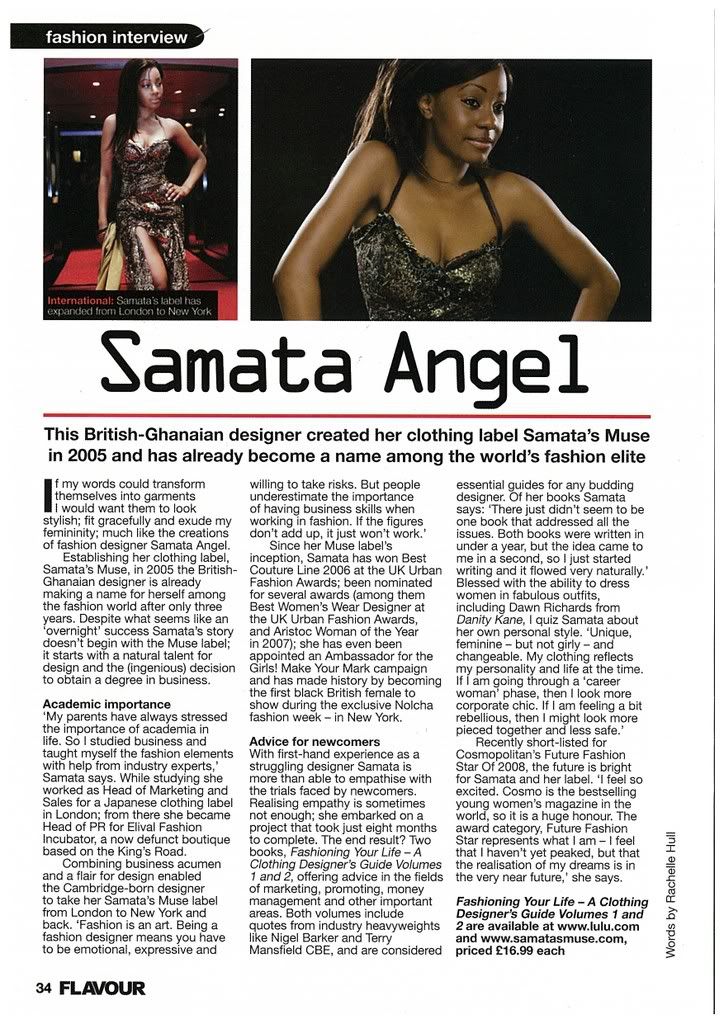
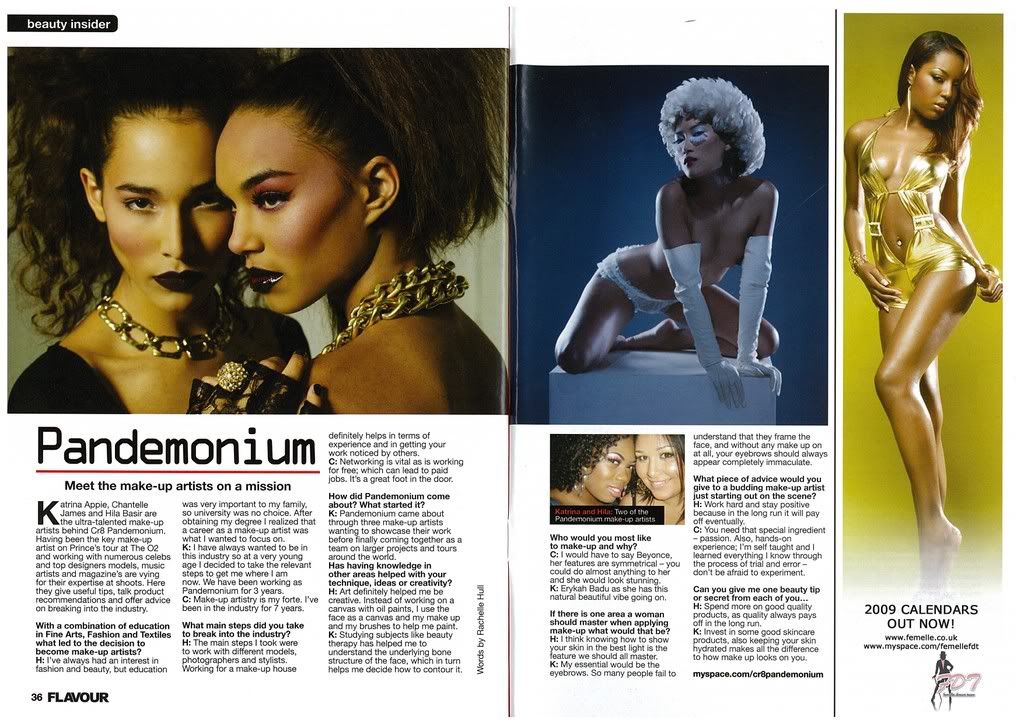
Interviews: SAMATA ANGEL and PANDEMONIUM

*Double click images for a larger view


FASHION DESIGNER: Samata Angel


MAKE-UP ARTISTS: Pandemonium


© Rachelle Hull
Published at
www.flavourmag.co.uk

LinkWithin

Related Posts with Thumbnails